
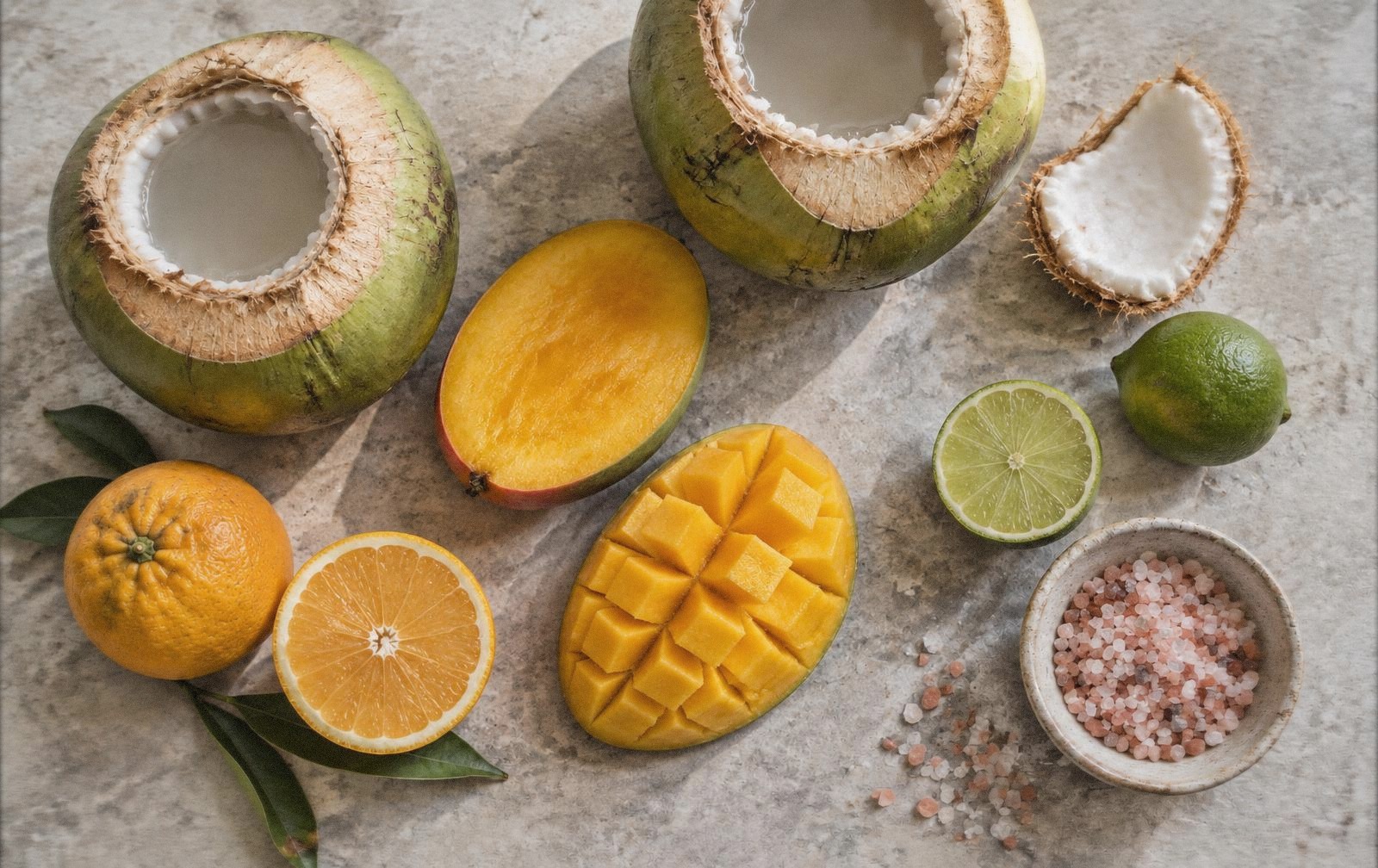
Ingredients
Written against our approved nutrition panel.
Nutrition information
Per 10 g serving, dissolved in 850 ml of water. Tap a row to see what it does.
The mineral this climate genuinely takes from you. Necessary for normal water and electrolyte balance.
Plus allulose, taurine, glycine, fruit powder and extract, coconut water powder and steviol glycosides. 25 servings per pack.
Free from
Sodium - 1,000 mg
Sodium is the mineral this climate genuinely takes from you. It is necessary for normal water and electrolyte balance, and it is the one a fresh, home-cooked diet is least likely to replace. We use sodium chloride alongside Himalayan salt.
Potassium - as potassium citrate
Potassium works against sodium, driving the exchange behind every nerve signal and every muscle contraction you make. It is necessary for normal water and electrolyte balance, contributes to the normal functioning of the nervous system, and contributes to normal muscle function. We use the citrate form because it dissolves cleanly and absorbs readily.
Magnesium - 125 mg, as magnesium citrate
Magnesium contributes to normal energy metabolism, is necessary for normal electrolyte balance, and is necessary for normal nerve and muscle function. It also contributes to normal psychological function, contributes to the reduction of tiredness and fatigue, and is necessary for the maintenance of normal teeth and bones.
Modern life draws on all of it. Hard training burns through magnesium, stress hormones pull it out of storage, and alcohol and sugar accelerate the same exit. We use citrate because form decides whether a number on a panel ever becomes magnesium in your body.
Calcium - as calcium citrate
Calcium is necessary for the maintenance of normal bones and teeth and contributes to normal muscle function. Citrate again, for the same reason as everything else in the premix.
The decision that defines the formula
Why every mineral here is a citrate
Minerals cannot exist alone in a powder. Each one has to be bound to a partner compound, and that partner determines how much of the mineral your body actually takes up. Oxides are cheap, dense and poorly absorbed. Citrates cost more and dissolve readily.
We chose citrate for the magnesium, the potassium and the calcium. Not one of them as a headline and the rest as filler. All three.
What we use
Citrate starts dissolving the moment it hits your water, and breaks down easily in your stomach - so your body can actually use it.
Source: Lindberg JS et al., Journal of the American College of Nutrition, 1990. Lab results on magnesium forms, not a test of this product.
A number you cannot absorb is not a dose. It is a claim.
B vitamins - B1, B2, B3, B6
Four of them, with B6 at 100% of your daily reference intake.
Vitamins B1, B2, B3 and B6 all contribute to normal energy-yielding metabolism. B2, B3 and B6 contribute to the reduction of tiredness and fatigue. B1, B2, B3 and B6 contribute to the normal functioning of the nervous system.
Minerals move water. B vitamins are part of how your body turns fuel into usable energy. Both matter on a long day in heat, so both are in here.
Allulose
Allulose is a rare sugar. It occurs naturally in figs and raisins, it tastes close to sugar, and your body absorbs it but largely does not metabolise it - most of it passes through and leaves in urine. That is why this formula declares 7 g of carbohydrate and zero grams of sugar.
It is here to make a gram of salt drinkable without adding sugar to a hydration product. It does that job and nothing else, which is exactly what we wanted from it.
Taurine and glycine
Two amino acids, both chosen deliberately.
Glycine is worth understanding. Sodium does not cross the intestinal wall unaided - it needs a transport partner. Glucose is the partner used in oral rehydration solutions, and glycine has its own independent sodium-coupled pathway that does not require sugar at all. It is an approach studied as an alternative to glucose-based rehydration.
We are not going to overstate it. The research on adding amino acids to rehydration formulas is mixed, and dilution matters as much as any single ingredient. But it is a considered inclusion, not a label decoration.
Real Citrus and Mango
Two flavours, both from real fruit used lightly. Real Citrus is sharp and clean, and cuts through the salt. Mango is rounder and softer, closer to the fruit itself than to anything you would find in a soft drink.
The point is not to bury the minerals under flavour - it is to make a salty drink you will actually finish and look forward to drinking again.
Dehydrated coconut water
Kelapa muda has rehydrated these coasts for as long as people have lived on them, and we wanted it in the formula that carries this island's name. It sits alongside the mineral premix rather than in front of it, contributing character and trace minerals.
Steviol glycosides
Sweetness has to come from somewhere, and it was not going to come from sugar. Steviol glycosides are derived from the stevia leaf and used in very small quantity - enough to round off a gram of salt, not enough to make this taste like a soft drink.
Because it should not. Coconut water has never been a sugary drink and neither is this. It is soft, faintly savoury, a little salty. That is the taste of something your body needs rather than something engineered to be craved.
What it tastes like
Not like a sports drink.
This is soft, faintly savoury, a little salty. Coconut water gives it that character - kelapa muda has never been a sugary drink, and neither is this. There is a gram of salt in every serving and we have not tried to hide it.
Most electrolytes are built to disguise their own minerals. Sweetness gets layered on until the salt disappears and you end up drinking something closer to a soft drink than a hydration product. We went the other way. The sweetness here is light, and it is there to round the salt off rather than cover it.
The result tastes like what it is. People coming from the big imported brands tend to describe it the same way: less sweet, easier to finish, and it does not leave you thirsty afterwards.